

On September 8, Meta launched Muse, a personal AI agent that books your dinners, cancels your forgotten subscriptions and fills in your forms for you.
Ten days later, it was the #1 free iPhone app in the US.
The easy explanation? Meta has infinite money and 3 billion users. Sure. But that explains less than you’d think. Muse hit #1 with fewer downloads than ChatGPT had at launch: about 41K a day in its first two days, vs 83K.
What got it there is a growth machine: a waitlist, referral tokens, a ratings engine, a cute little mascot, Apple Ads everywhere…
Let’s break it down.
10 days, from launch to #1
Here’s the timeline:
Sep 7: closed alpha, with a waitlist and invite codes (TestingCatalog)
Sep 8: US launch on iOS, Android, muse.ai and WhatsApp (Meta)
Sep 9: first Meta ads go live
Sep 12–13: ratings jump from 422 to 2,270 overnight
Sep 17: Mac app arrives
Sep 18: Canada launch, new ad wave, and Muse is #1 overall
Sep 20: still #1, ChatGPT at #2 (Mixed)
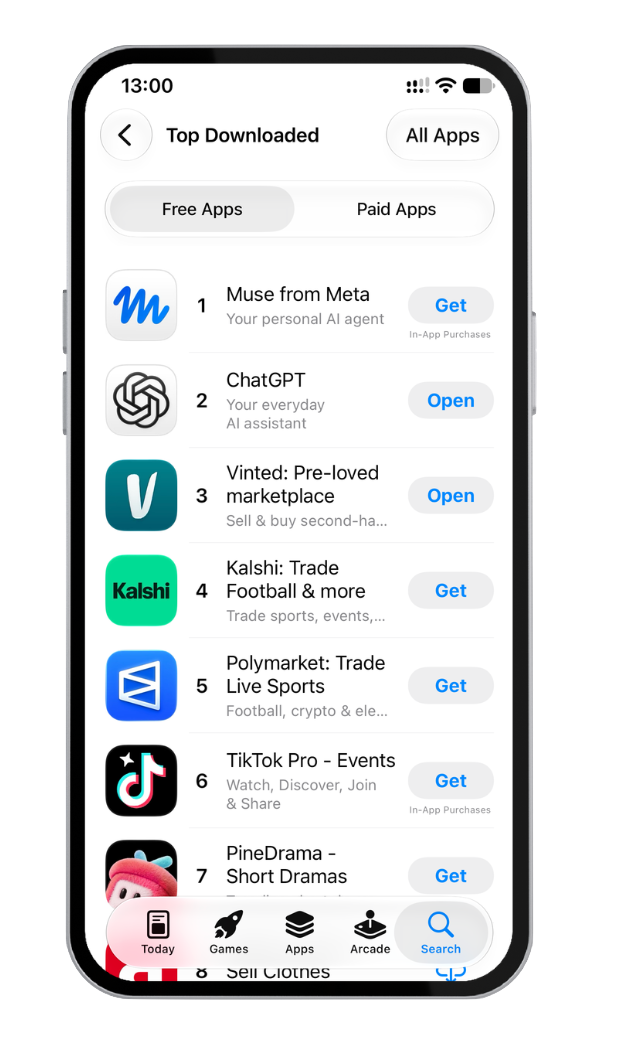
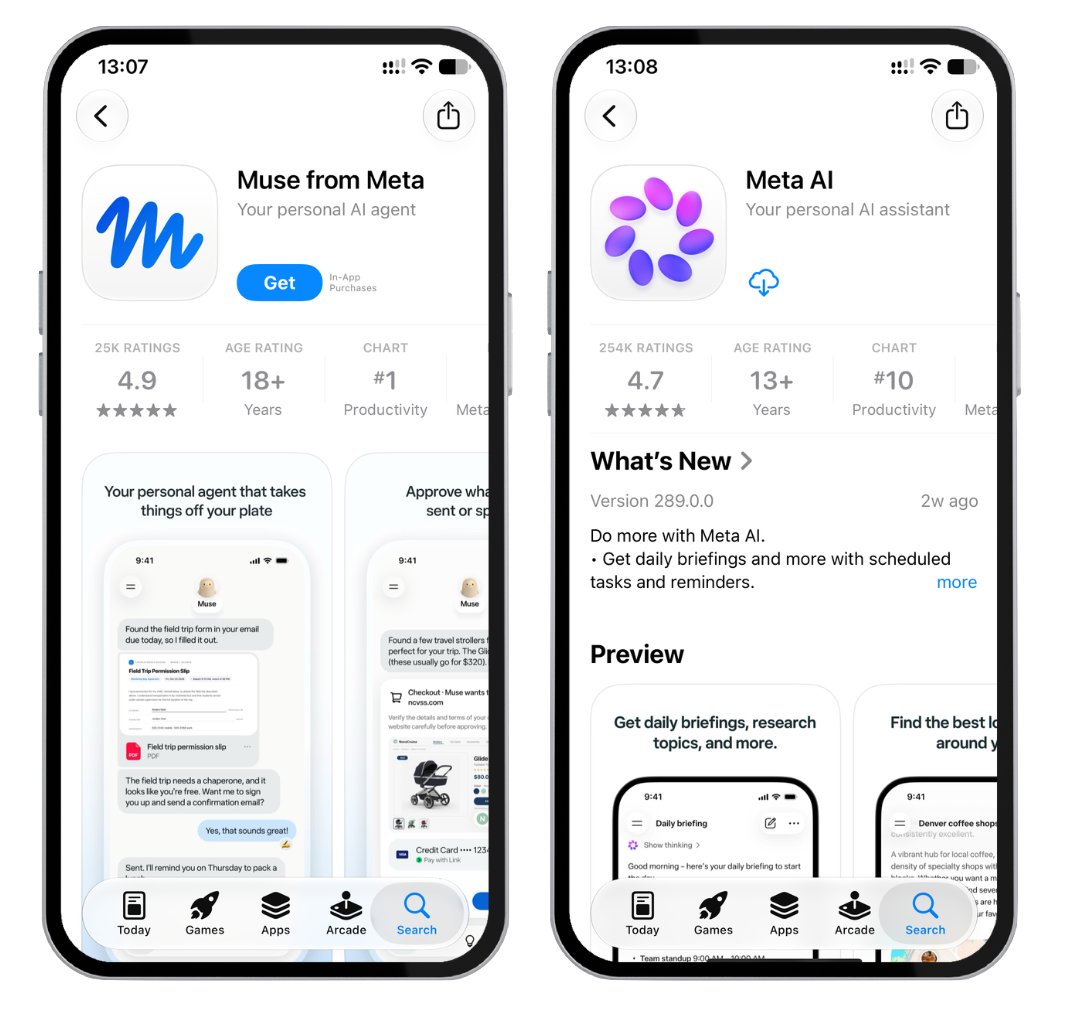
A product page that says clearly says agent, not assistant
Clean product page and appears in search next to its big sibling, “Muse from Meta: Your personal AI agent” right next to “Meta AI: Your personal AI assistant”.
Same brand system, one word apart.
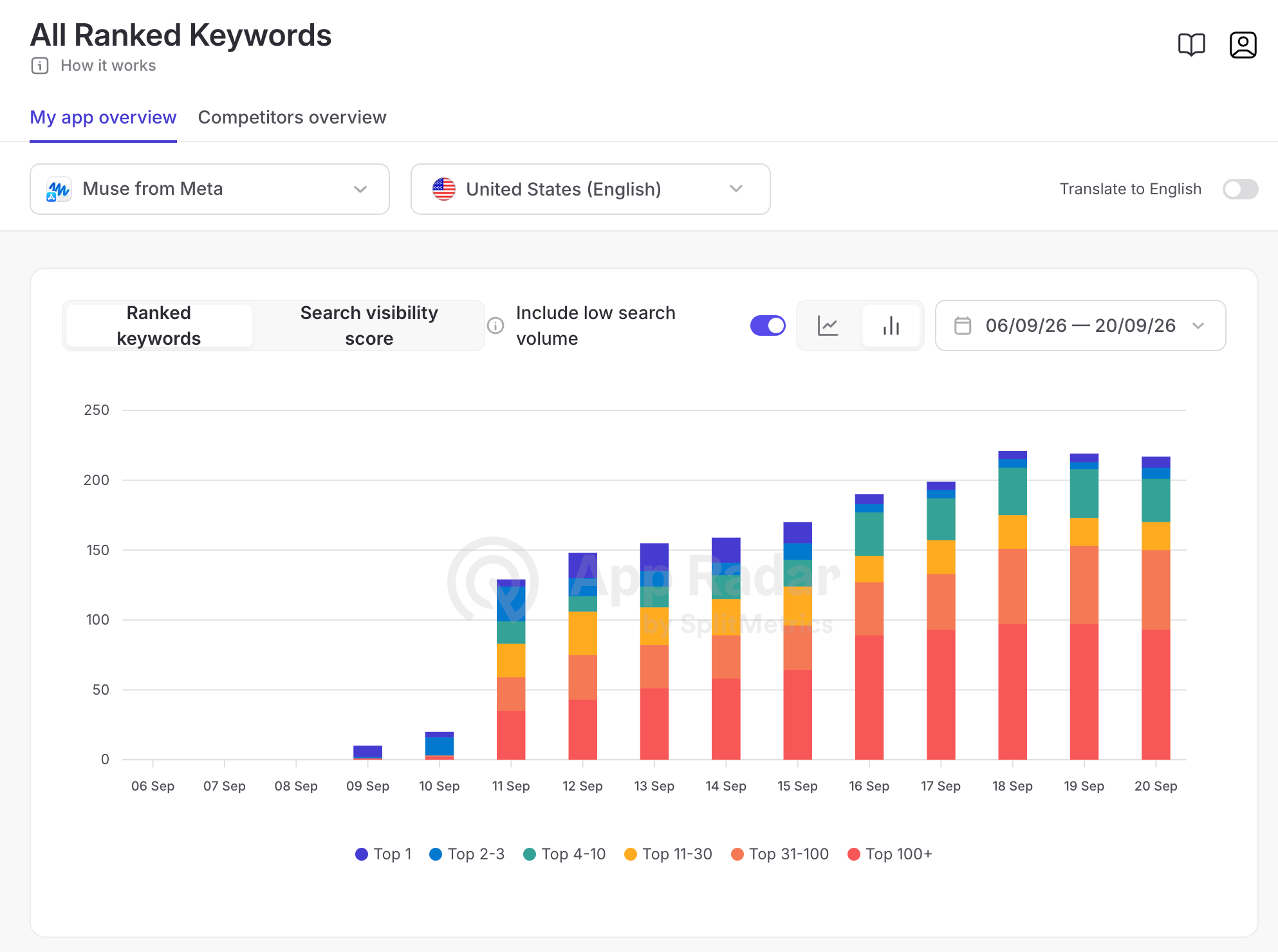
Organic search, though, isn’t the engine yet. Muse ranked for about 217 US keywords on Sep 20, with around 45 in the top 10 and 70% outside the top 30 (App Radar). The generic AI keywords are saturated already, but giving a bit more time the app might be able to pull more traffic from organic, like Meta AI which is now appearing against 5000 terms in the US (AppRadar).
Every paid placement on the App Store
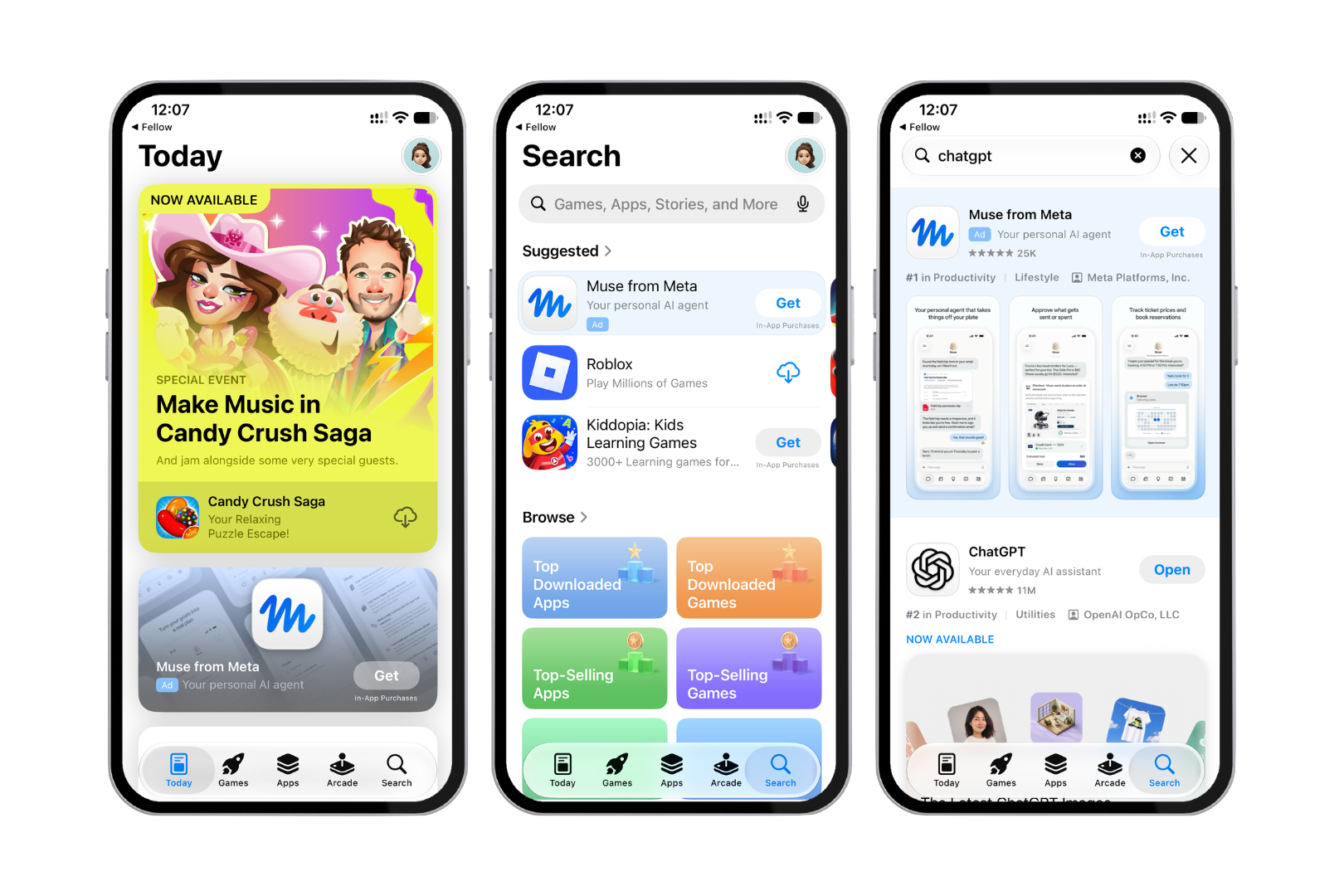
Muse is all over the App Store. In one visit to the US store, I found Muse in 3 out of 4 Apple Ads placements:
Today tab: an ad card right under the day’s lead story
Search tab: the “Suggested” slot, before you type anything
Search results: above ChatGPT’s own listing, and other generic + competitor keywords, as well as protecting their own brand
Two details worth noticing:
The Search results ad shows Muse’s chart rank, and displays “#1 in Productivity”. Paid installs push the rank, the rank badge makes the ad more convincing, and the ad brings more installs.
It’s conquesting the biggest brand term in the category. Search for ChatGPT and you see Muse first, with already 25K ratings and the approval screenshot in view.
Missing Product page placement, or at least I haven’t seen it during my research. This could be an interesting one to appear on top competitors page.
The playbook: check who’s bidding on your brand keyword today. Your brand term isn’t safe, and a brand campaign is usually your cheapest cost per tap. Done well, a competitor can grab high-intent users who were about to download your app. Keep the Today tab and Search tab for launch weeks, and only if budget allows. Those buy reach, not efficiency.
🎯 You Might Also Like:

A ratings engine
25K ratings in under two weeks, averaging 4.9. Where does that come from?
Stars, not reviews: About 3,000 new ratings a day, but only 65–90 written reviews. More than 97% are stars only, which most likely means it’s coming from Apple’s in-app rating prompt.

It switched on overnight and ratings went from 422 to 2,270 between Sep 12 and 13, with no app update (version 7.1 only shipped Sep 17). Most likely a server-side switch.
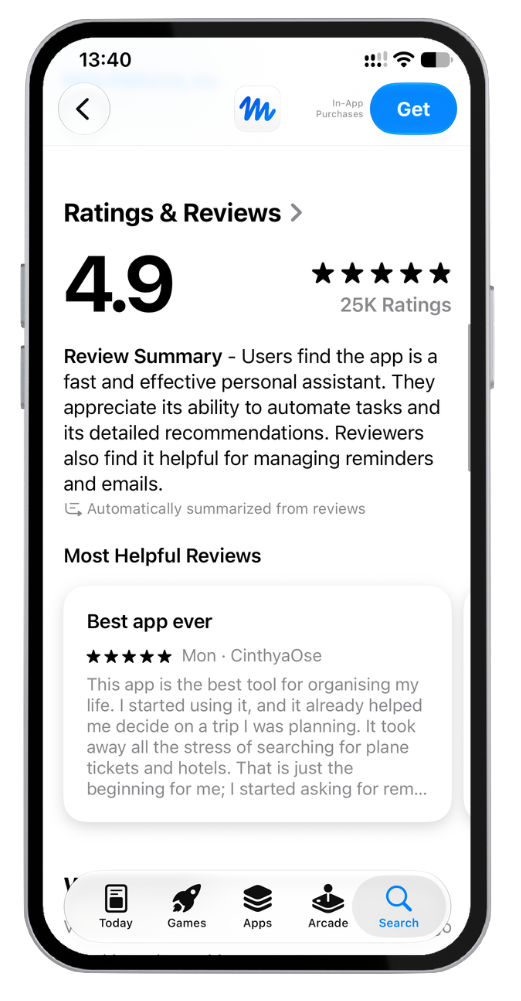
The playbook: Apple lets you show the prompt only 3 times a year per user. Tie it to a success event, so you have higher chance to get a positive review.
A waitlist, then a referral loop
This one is a really good growth strategy, for sure.
It started with a waitlist. The App Store listing was open to everyone in the US, but the product wasn’t: people downloaded, signed up… and waited. Every one of those downloads still counted for the charts.
And the way off the waitlist? An invite code.
Every invite gives 1 billion tokens to both people. That’s about ten weeks of the free plan. Each code works 20 times and has to be used within 48 hours of signing up.

Tokens cost Meta compute, but users see them as money. So the codes spread everywhere:
freebie forums and tech headlines
press articles: iPhone in Canada’s launch story ends with one
inside App Store reviews: one 5-star “review” is literally just a referral code
Another reviewer: “The referral program is legit too, got a billion tokens from inviting one friend.”
The playbook: Think about how referral could work in your case. Adapty’s guide to building a referral program covers the essentials:
double-sided rewards (91.2% of successful programs, per Adapty)
asking at a moment of delight
deferred deep links, so the referral survives the App Store install
Three Instagram accounts, one story
Three accounts, three jobs.
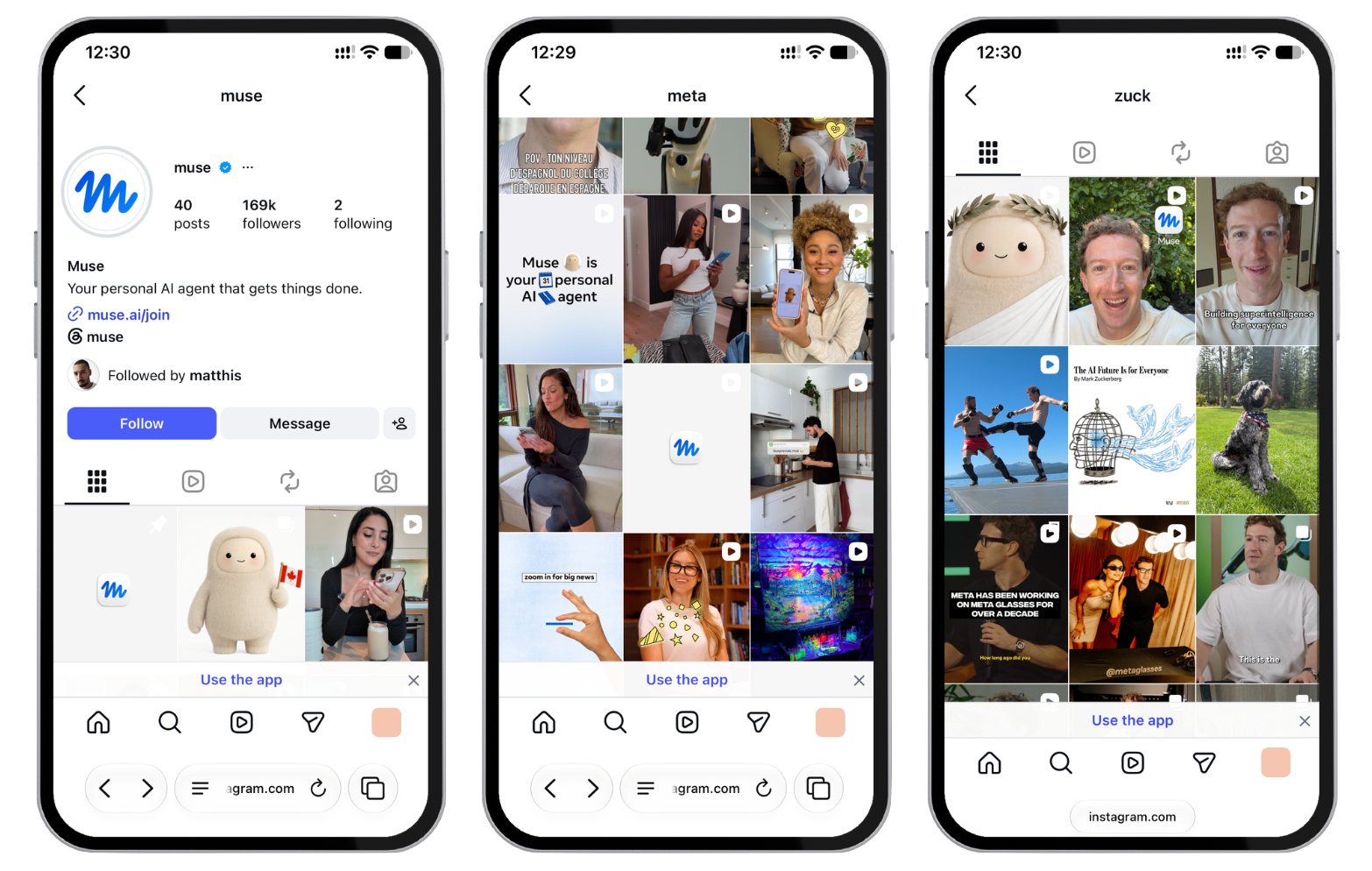
@muse shows the personality: with 40 posts and 169K followers, on a handle taken from a rock band (more on that below). The grid mixes:
A cute little mascot. As usual… Meta bought the trend. You can even rename it: reviewers call theirs Milo, R2d2, Phoenix… or Zuck.
the mascot, including waving a Canadian flag for the Sep 18 Canada launch, with Meta asking “Where to next?”
creator-style videos of people using Muse at home
chat screenshots
the @muse bio links to muse.ai/join, Meta’s own web signup. Instagram traffic lands where the plans are 20% cheaper and Apple takes no cut.
Stories reshare Zuck’s reel with a “Download Muse” link sticker.
@meta brings the reach as Muse sits between Meta’s other launches: the mascot post, creator videos, a WhatsApp demo.
@zuck sells the vision. His grid has the mascot in a laurel crown and toga (a muse, get it?), a selfie reel with the Muse sticker, a “Building superintelligence for everyone” reel and his July WSJ op-ed, “The AI Future Is for Everyone”. Muse lands as the payoff of a story he started telling two months before launch.
The playbook: the founder says why, the product account shows how, creators prove it. And if you sell on the web, point your bio there.
Distribution nobody else can buy
Some of this, you just can’t copy.
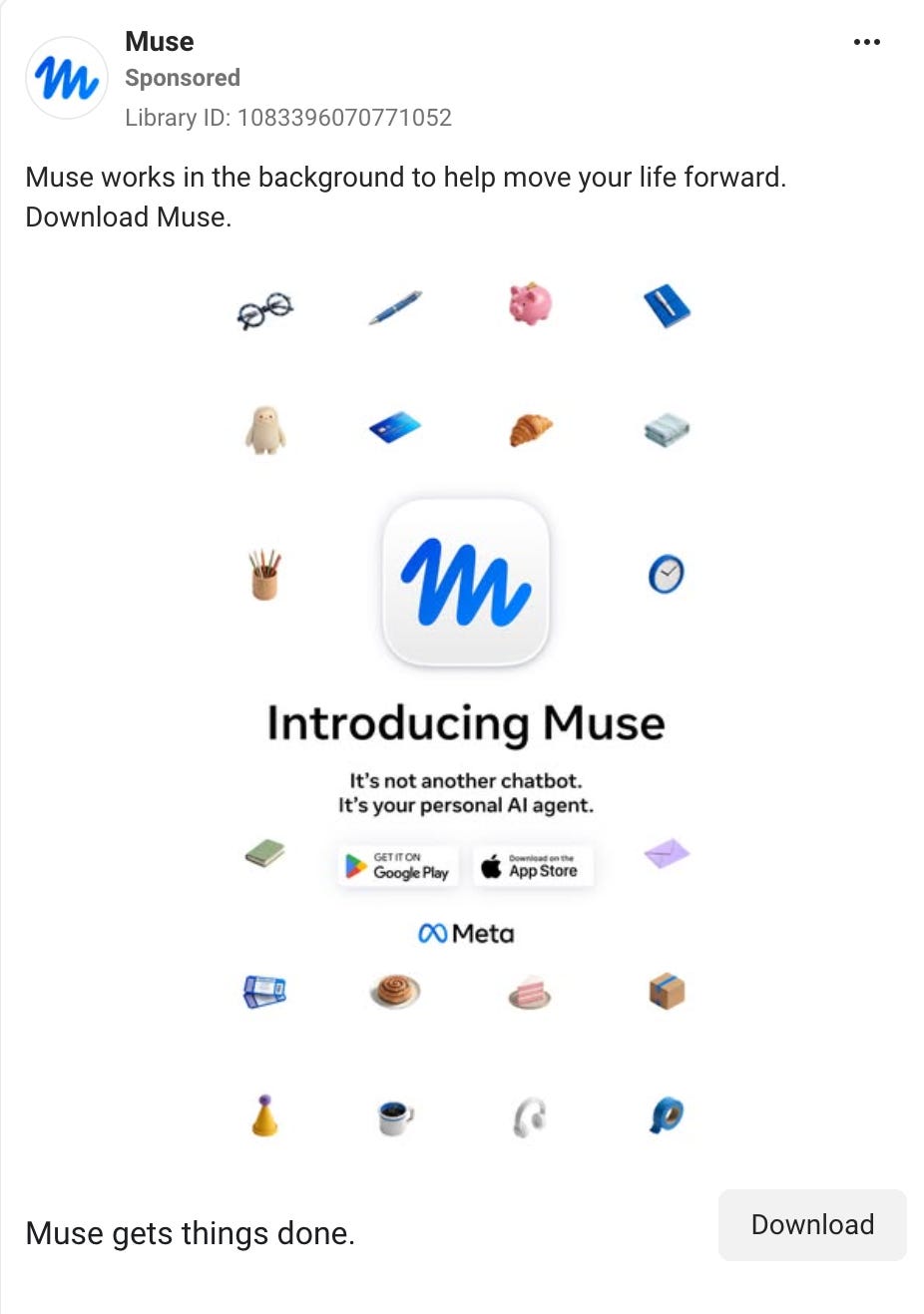
53 Meta ads since Sep 9, plus a new “Introducing Muse” wave on Sep 18, the day it hit #1.
WhatsApp, no install needed where you can text Muse like a contact.
The @muse handle. The band Muse moved from @muse to @museband on Instagram and X over the summer, months before launch (Engadget). Meta did the same with @meta in 2021 and @threads in 2023. Executives’ launch posts even tagged the band by mistake.
Cross-platform with iOS, Android, web, WhatsApp, a Mac app from Sep 17, and Canada from Sep 18.
A lot of PR, even the bad one about privacy.
The playbook: get a contact a Meta and ask them to change the handle of your future app if not available. Jk, just launch static Meta ads at launch, and think about how your app might be used across devices.
What you can learn from it
You might not have Meta’s budget, or its distribution, but there are a few things worth taking from this launch: the founder storytelling, the PR, the waitlist… and most of all, the referral program and the ratings machine.
But being #1 doesn’t mean they’ve made it yet.
The real challenge now is retention. Especially once the bonus tokens run out, and users have to decide if Muse is worth $20 a month.
📣 Good ideas are better shared.
Send this to your team, or anyone building an app right now, they might find it useful!