
TikTok’s U.S. Move Just Reshuffled the App Store
Skylight, Upscrolled, and the App Store Shift Happening Right Now

Over the past few days, the Social Networking charts have started doing something unusual with new apps climbing fast. Familiar giants are being outranked.
This kind of movement rarely comes from a single viral post or a clever launch.
It usually happens when something external shifts user behavior all at once.
That shift is happening right now.
🎯 Read my 2026 Predictions:

TikTok U.S. has now officially moved to the U.S.
Last week, TikTok confirmed the creation of a new U.S. based entity, backed by American investors, designed to comply with U.S. regulation and avoid a potential nationwide ban.
From a corporate and regulatory standpoint, this was positioned as a stabilizing move with local ownership and clearer governance.
But moments like this are never neutral for users.
Structural transitions come with rewritten terms, updated privacy policies, and subtle changes in how responsibility, access, and control are defined. Even when the product experience stays the same, the relationship between the platform and its users shifts.
This wasn’t a loud announcement in the app. It was rather quiet, very legal and procedural.
Which is exactly why people paid attention.
Why users are uneasy
The reaction to TikTok’s transition has been driven by new terms in the privacy policy. What surfaced repeatedly across Reddit threads, complaint forums, and press coverage was the explicit introduction of precise location tracking, which hadn’t been part of the policy before.
Adding to this, some users also pointed to wording that appeared to allow broader use or sharing of sensitive attributes, including citizenship or immigration-related status, depending on jurisdiction and enforcement context.
In the current U.S. climate, with heightened immigration enforcement, political tension, and growing skepticism toward institutions, precise location tracking does feel worrying and personal. It raises questions that go beyond product features and into trust, exposure, and control.
Most users already assume large platforms collect data. What unsettles them is when a platform asks for more; especially when that request coincides with a major governance change.
This is what makes this moment different from previous TikTok controversies. The reaction is situational. People are saying that they’re not comfortable agreeing to this now.
When trust cracks, charts move
When users hesitate, they don’t always delete an app immediately. Instead, they pause, they delay updates, reduce usage, and eventually.. they start looking around.
That’s when charts move.
Moments of trust uncertainty create a brief window where users are open to alternatives, because they are actively willing to explore.
In those moments, the App Store becomes less about loyalty and more about availability.
This is exactly the kind of environment where smaller apps can surface unexpectedly.
Attention temporarily fragments; and fragmentation is enough to reshuffle rankings in a category as competitive as social.
🎯 You might also like:

What Skylight & Upscrolled get right
1. Skylight, the open-source alternative to algorithm-heavy social feeds
Skylight positioning matters more than any individual feature.
Launched just last year and backed by investors, the app is built on the AT Protocol, the same decentralized foundation that powers Bluesky, which now counts more than 42 million users.
Skylight positions itself as a short-form, vertical video app reminiscent of TikTok, but with a radically different posture: open source, lightweight, and transparent by design. That positioning suddenly resonated as it signals restraint, visibility, and alignment with user interests at a time when opacity feels risky.
Following TikTok’s U.S. transition, Skylight crossed 380,000 total users, with growth accelerating sharply over a single weekend. According to the team, the app added around 20,000 new users in just a few days, pushing January monthly active users to roughly 95,000.
Skylight simply needed to be present as a credible option when people were ready to look elsewhere.
2. UpScrolled, the transparent & censorship-free alternative to mainstream platforms
Upscrolled benefited from a similar dynamic, but at an even more extreme velocity.
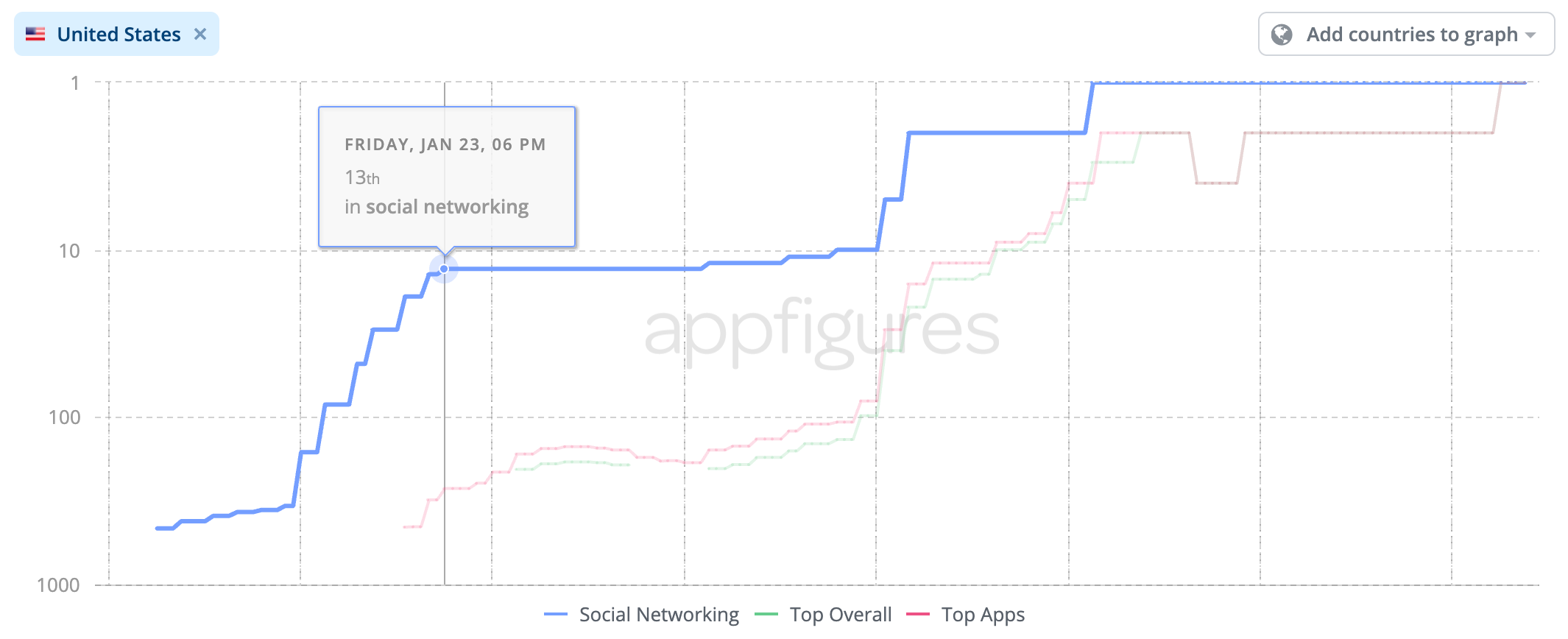
According to data from Appfigures, Upscrolled recorded approximately 41,000 downloads between last Thursday and Saturday, immediately after TikTok finalized its U.S. deal. That short window alone accounted for nearly one-third of the app’s lifetime installs.
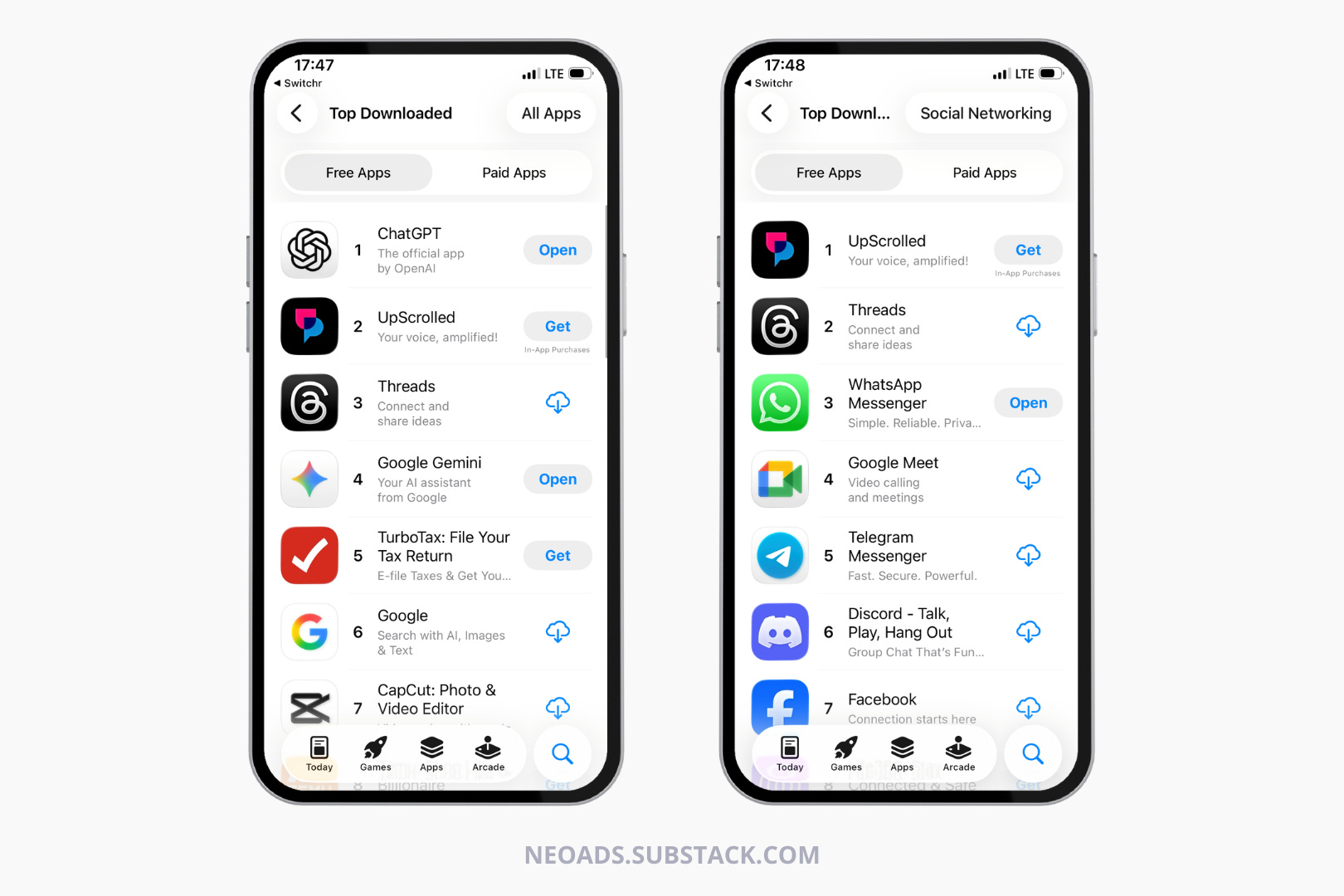
On January 29th 2026, it reached the #1 spot in the U.S. Social Networking chart, ahead of apps like Threads and WhatsApp.
It happens because users are actively sampling alternatives.
Upscrolled’s appeal is subtle but well-timed: free expression, support for different media types, a simple feed, no visible AI positioning, and a general feeling of being lighter and less intrusive.
Growth Opportunities
Both Skylight and Upscrolled did the hard part already: they were present when demand leaked. Now the question is both simpler and harder: how do you lock in trust at the store level?
Skylight: strong positioning, under-leveraged store page
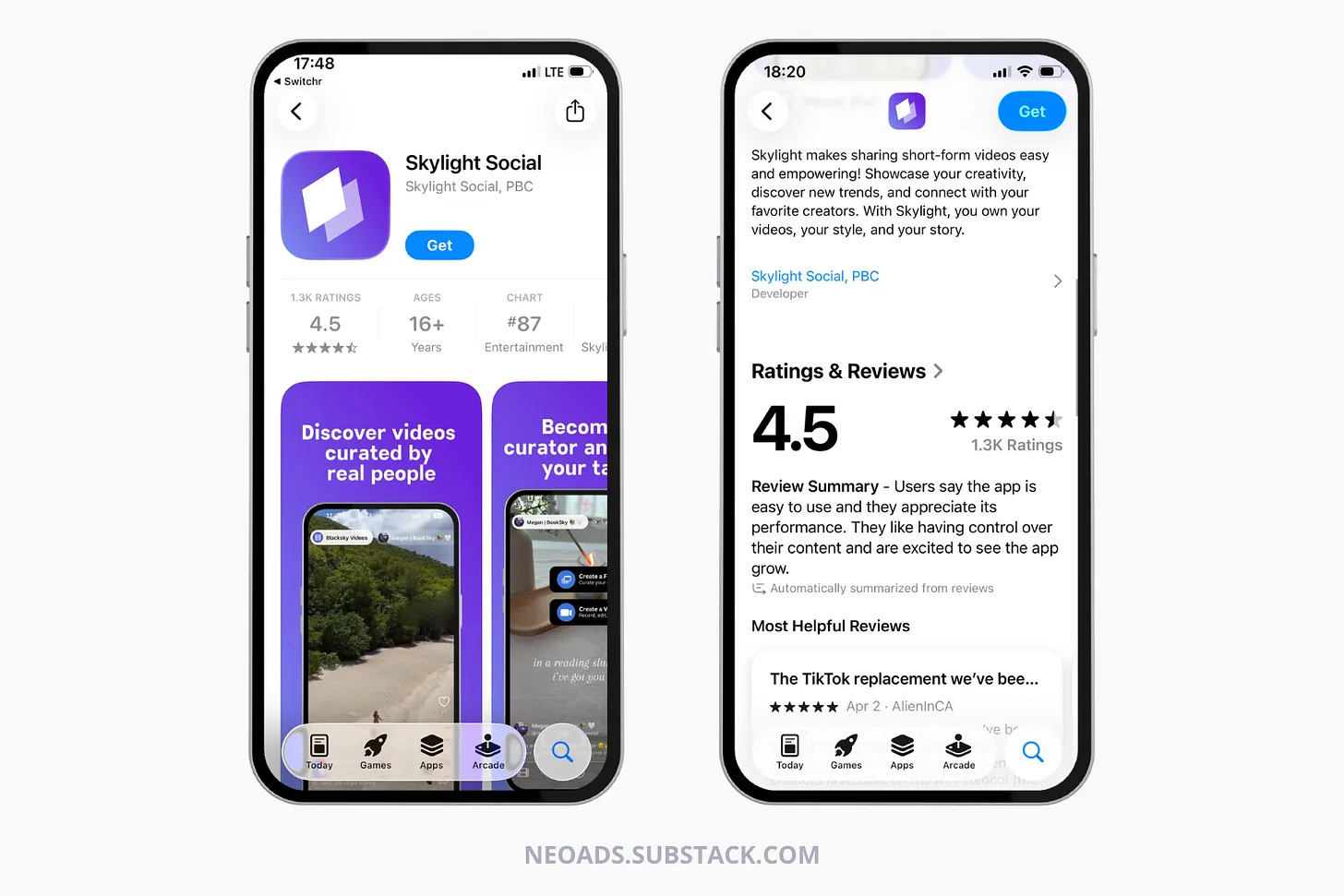
Skylight’s biggest strength is clarity of intent. Open source, decentralized tech, and a TikTok-like format without the opacity. Unfortunately, it does not translate well inside the App Store.
Right now, the page still leans a bit too much on what the product does, and not enough on why it exists; which is exactly what users care about in a trust-driven moment.
ASO opportunities:
The title and subtitle could be sharper about differentiation: openness, transparency, independence.
The screenshots are the biggest opportunity: frame-1 should immediately answer the question users are asking when they arrive: “Why is this safer / different?”
Call out open-source explicitly
Explain what Skylight does not do
Reinforce simplicity and user control
The description is way too short and conservative, while it could be more opinionated & confident.
Upscrolled: massive momentum, but fragile conversion layer
Upscrolled’s growth is explosive, which comes with risk.
When an app jumps from niche to #1 in days, the App Store page becomes a bottleneck. Every ambiguity costs installs and every vague message increases bounce.
Upscrolled’s product philosophy is actually very compelling: free expression, multiple media types, no visible AI layer, and a feeling of being quieter and less extractive.
But that story isn’t yet obvious enough at first glance.
ASO opportunities:
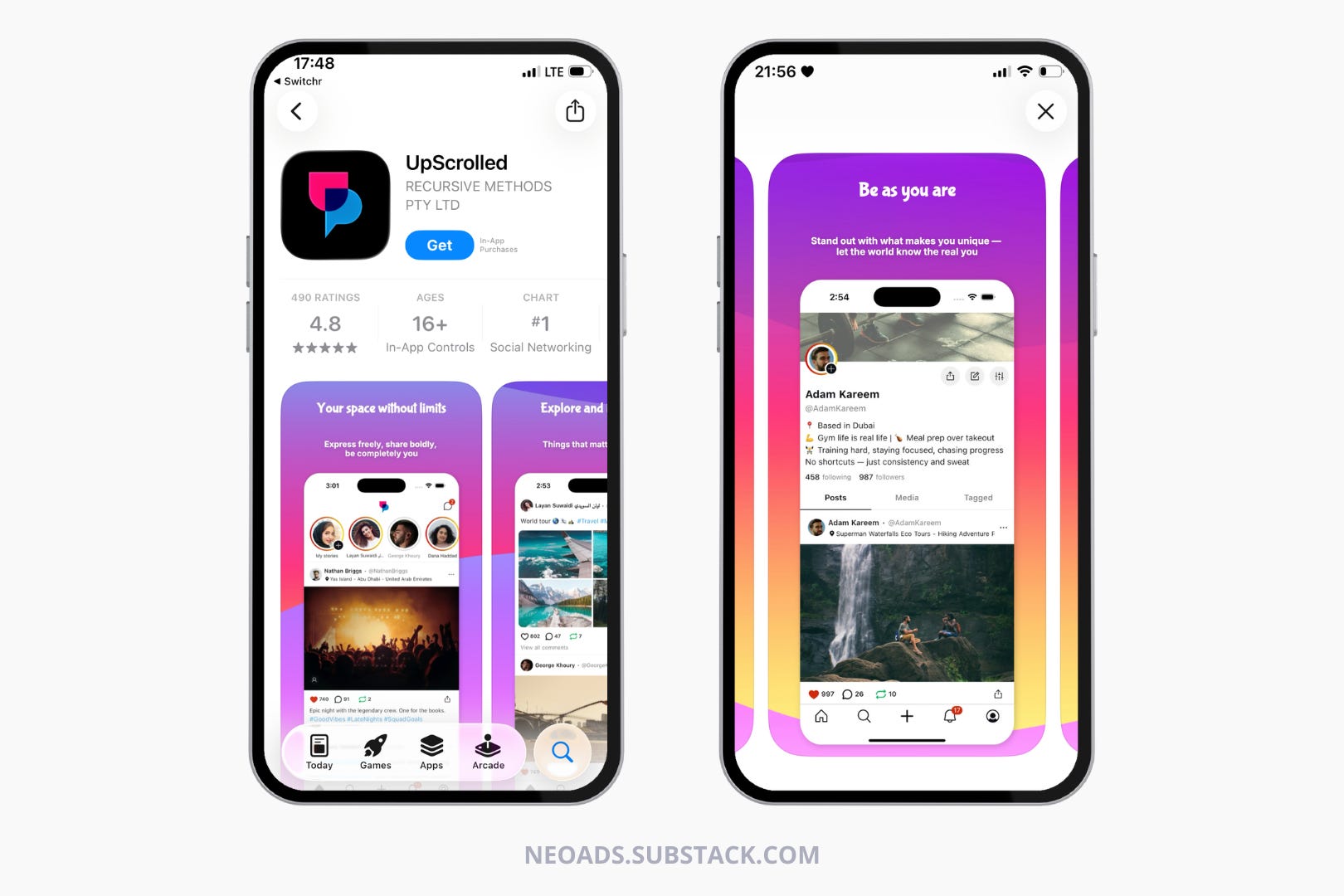
The title and subtitle currently undersell intent: expression, simplicity, or independence should be mentioned.
The screenshots should move faster and do narrative work. Users need to understand why the feed exists.
Copy should be bigger
Highlight values more than features: “freely express thoughts, share moments, and connect with others”, as mentioned on the app’s website
Reinforce privacy and user control
App icon feels slightly heavier and more “engineered” than the product experience itself.
This matters more than it sounds as during spikes, users scan fast and visual friction hurts conversion.
The growth takeaway
This moment isn’t about TikTok failing, but about trust becoming more important than ever.
Governance changes, privacy updates, and policy shifts are no longer background noise. Users notice them, discuss them publicly, and factor them into their behavior.
For growth teams and founders, the takeaway is simple but uncomfortable: distribution leaks at moments of institutional change.
If you’re building in social, wellness, finance, or any category that touches identity or personal data, your privacy posture is part of your funnel. Your values need to be legible in seconds. And your App Store page needs to confirm a story users have already heard elsewhere.
Skylight and Upscrolled didn’t create this demand, but they were ready when it appeared.
✨ Want to stay ahead in iOS Growth?
Subscribe now & get the latest trends delivered straight to your inbox!